During Bethel’s commencement exercises last month, our speaker told the soon-to-be graduates the story of the British evangelical politician William Wilberforce, who dedicated his life to the abolition of the slave trade (accomplished in 1807) and then slavery itself (just before his death in 1833). Up on stage among the berobed faculty, my friend Sam and I glanced at each other.
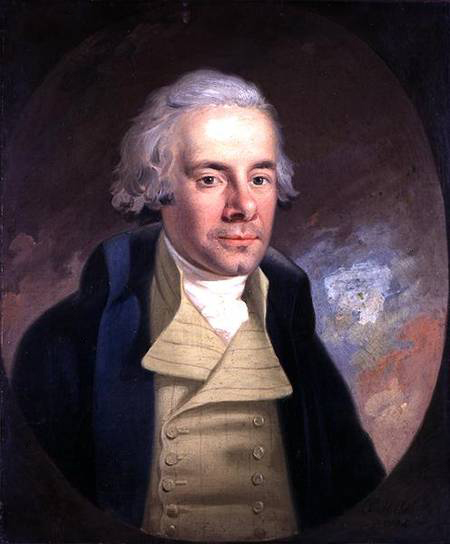
See, just days earlier we had been wondering aloud, “When did William Wilberforce become so widely recognized as a landmark figure in history?” I had just told his story at the end of the final lecture in the Western Civ survey Sam and I both teach, having already told longer, more problematized versions of it earlier that spring in my Human Rights history course and the fall before in my Modern Europe survey. And I know I’m far from unusual on our faculty in paying such attention to one British politician from the turn of the 19th century.
Indeed, I have no doubt that when the commencement speaker said the name “William Wilberforce,” a healthy majority of the students listening immediately recalled at least a Cliff Notes version of the story to their minds. At least, I hope they did: they’d heard the story that often.
But I also have no doubt that if the speaker at my graduation from the College of William and Mary in May 1996 had mentioned William Wilberforce, I would have had absolutely no idea who that was. And I was a history major headed for graduate school in the same field.
Another indication of how Wilberforce has been “trending” of late… According to Google, here’s how often his name showed up on the Web in each of the last ten years:
2012 - 21,900
2011 - 34,800
2010 - 18,800
2009 - 15,000
2008 - 11,300
2007 - 9,400
2006 - 4,150
2005 - 2,130
2004 - 1,310
2003 - 820
 To some extent, this is easy to explain, and fairly predictable. When the movie Amazing Grace, which told the British abolitionist story with Wilberforce at the center, came out in 2006, the number nearly doubled — indeed, it nearly equaled the previous three years combined. That, of course, was in anticipation of 2007, the 200th anniversary of the British parliament finally adopting Wilberforce’s motion to abolish the slave trade, when the number more than doubled. What’s more remarkable is that the number doubled again from 2007 to 2010, then nearly again in the following year alone!
I’m sure part of this reflects better archiving by Google of the escalating amount of content published to the Web in a greater variety of forms. But it still seems reasonable to conclude that William Wilberforce has, in the second decade of the 21st century, achieved a level of popularity and interest that he hasn’t known since his death, in the fourth decade of the 19th.
Now, in some circles, Wilberforce has always been popular. For example, in the decade that I spent in college and graduate school (1993-2002), Christian publishers debuted or reissued biographies titled (or subtitled) A Man Who Changed His Times, God’s Politician, Freedom Fighter, (separately) The Freedom Fighter, Statesman and Saint, and Vital Christianity. A 1997 issue of Christian History was dedicated to Wilberforce and the “century of reform” that followed from the abolitionist movement, and Os Guinness and John Piper both turned to Wilberforce in writing books about Christian character and leadership. In addition, Baptist and evangelical institutions approved at least half a dozen master’s theses featuring Wilberforce. One such student, Kevin Belmonte of Gordon-Conwell, then edited a collection of Wilberforce’s prayers and other devotional writings and contributed an afterword to a reprint of The Life of William Wilberforce, a five-volume biography written by two of his sons in 1838. In 2002 Belmonte’s own biography of the man (Hero for Humanity) came out from NavPress.
In the same period, not a single Wilberforce-related work came out of a secular institution. (All this according to a WorldCat search.)
This kind of attention from evangelicals and other Christians is nothing new. During the relatively fallow period of interest in Wilberforce spanning the late 19th and much of the 20th centuries, groups like the American Tract Society, the Religious Tract Society, the Protestant Episcopal Society for the Promotion of Evangelical Knowledge, and the Society for Promoting Christian Knowledge kept publishing new biographies and reprinting old documents from the abolitionist movement.
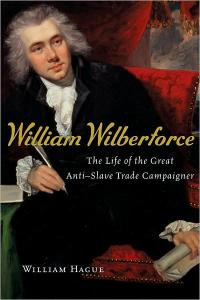 Then since Amazing Grace was released in 2006, a small flood of Wilberforce books has poured forth. To be sure, evangelical publishers have again led the way: Zondervan reissued Belmonte’s biography in 2007; Crossway published yet another John Piper book featuring Wilberforce; Eerdmans put out Stephen Tompkins’ biography; and smaller houses like Day One and New Leaf hopped on the bandwagon as well.
But it’s also noteworthy that the popular Eric Metaxas biography that accompanied the film was released by a division of HarperCollins, whose British imprint published another biography of Wilberforce by British politician William Hague. Cambridge University Press has recently reprinted the 1838 Life of William Wilberforce, a multi-volume edition of his correspondence, and Ford Brown’s 1961 Fathers of the Victorians: The Age of Wilberforce, and this past April Oxford published Anne Stott’s Wilberforce: Family and Friends.
It’s also worth noting that 2006 was the year that journalist Adam Hochschild published his own take on the British abolitionists, a version that downplayed the significance of Wilberforce to the benefit of the more radical (in politics and religion) Thomas Clarkson, who himself (as Hochschild points out) was treated rather shabbily in the Wilberforce sons’ biography of their father.
So what do you think has been happening?
Is Wilberforce’s popularity chiefly driven by evangelicals and other Christians? (Examples: The late Chuck Colson founded the Wilberforce Forum as a conservative Christian think tank, growing out of his Prison Fellowship, which gives an annual Wilberforce Award. Progressive evangelical leader Jim Wallis invokes Wilberforce side by side with MLK and professed himself “deeply inspired” by the 2006 movie. Here in Minnesota the St. Paul-based Wilberforce Academy is an evangelical Christian organization that trains college students to “graciously bring the truth of a Christian worldview to bear on the deepest needs of their societies.”) Does the new attention paid to Wilberforce by secular publishers simply reflect their awareness of a growing religious market?
Or is Wilberforce becoming one of those figures that — as blogger Matthew Schmitz wrote earlier this year about Martin Luther King, Jr. — is part of a “common, substantive moral inheritance” shared and invoked by people across the political spectrum and of different religious convictions? (Two examples… Pres. Barack Obama closed his remarks to the 2010 National Prayer Breakfast by invoking three men: MLK, Abraham Lincoln, and Wilberforce; the website for The Wilberforce Society, a student think tank at the University of Cambridge, stresses its political neutrality and makes no mention of its namesake’s religious beliefs.)
 The Pietist Schoolman