Today I’ll recap the third of my three talks delivered on May 5-6 for Salem Covenant Church’s annual family camp, in the northern Minnesota woods at Covenant Pines Bible Camp. The overriding theme was to encourage Christian non-historians to approach church history with the same zeal that many of them apply to family history. I suggested three tools to help Christians encounter the past, each rooted in Scripture: first, the “great cloud of witnesses” (Heb 12:1) by which the past inspires Christians; second, asking whether we should “hold fast” to traditions (2 Thess 2:15), which suggests the past governs Christians. Finally, I came to what’s undoubtedly the least comfortable, most challenging tool: remembrance — which, I argued, disenchants Christians.
 Disenchanting? Here I had in mind a significant passage from the conclusion to Postwar, Tony Judt’s acclaimed history of Europe after 1945:
Unlike memory, which confirms and reinforces itself, history contributes to the disenchantment of the world. Most of what it has to offer is discomforting, even disruptive—which is why it is not always politically prudent to wield the past as a moral cudgel with which to beat and berate a people for its past sins. But history does need to be learned—and periodically re-learned. (p. 830)
It’s a notion that I use often in my Bethel courses, particularly in my 300-level Modern Europe survey, in which World War II is a pivotal moment. I typically devote an entire class period simply to considering how French, Germans, and other Europeans remembered what happened during the war. How the Germans deemed 1945 Stunde Null (“zero hour”) and tried to reset the clock, start over, and ignore what had happened under Hitler. How the French — after an initial frenzy of épuration that violently purged a wide array of “collaborators” from the nation — settled into a set of comforting myths (Pétain was the villain; De Gaulle was the hero; everyone resisted… see Henry Rousso, The Vichy Syndrome) that permitted them to avoid the reality that the French, like most nations occupied by the Germans, collaborated with their conquerors, even to the extent of turning over French and foreign-born Jews.
As individuals, and as a people, French, German, and other European men and women engaged in a kind of forgetting that masqueraded as memory: one in which all that was painful or inconvenient was tucked away and stories of supposed virtue were told and retold until everyone truly did believe that they had resisted evil.
Of course, this all fell apart in the 1960s and succeeding decades, as a new generation asked provocative questions that were skillfully and persuasively answered by historians, artists, and others. But as the myths shattered and history disenchanted memory, these societies struggled to cope. And some did indeed find it politically advantageous to ask just what their opponents did in 1940-1945 — hence Judt’s warning not to wield history as a weapon.
Nevertheless, “history does need to be learned—and periodically re-learned.” And that’s true of the Church as well. While we more easily treat the past as a source of inspirational stories (that we think we get to choose to fit our own preferences) or as the source of traditions that resist reevaluation because they remove the need for us to make choices, what the Old and New Testaments call “remembrance” forces us to recognize that we are not in control of the past — either what happened or how it continues to affect us — and that we do not get to choose which stories are our stories. (I tried to contrast the self-reinforcing “memory” that Judt sought to disenchant with the self-aware “remembrance” taught in the Bible.)
It happened that the day before I left for Covenant Pines to give these talks, I gave the final lecture of the semester in Christianity and Western Culture survey (a 1st-year general education course taken by about two-thirds of Bethel students). I taught about imperialism between 1500-1800, with a heavy emphasis on European Christian complicity in the enslavement and murder first of the indigenous peoples of the Western Hemisphere and then of the Africans trafficked across the Atlantic Ocean. As I wrapped up the story of Spanish conquest and rapine, I paused to warn the students not to tell themselves that “I’m a Protestant; they’re Catholics” or “I’m American; they’re Spanish.” Like me, like my audience, those slavers (and the people, like Bartolomé de Las Casas, who criticized them) are members of the Christian family.
Their history is ours, and it can’t be dismissed any more than those relatives whom we dislike or from whom we’re even estranged can be erased from our family history.

To root this model of remembrance in Scripture (as I had done for the other “tools”), I turned to the Book of Deuteronomy, in which Moses seems constantly to be telling the Israelites to remember (or not to forget). Consider, for example, these bookends:
“But take care and watch yourselves closely, so as neither to forget the things that your eyes have seen nor to let them slip from your mind all the days of your life; make them known to your children and your children’s children…” (4:9)
“Remember the days of old,
consider the years long past;
ask your father, and he will inform you;
your elders, and they will tell you.” (32:7)
At the beginning of the book, Moses instructs those who have escaped Egypt both to remember what they saw and to communicate that memory to the next generations. At the book’s close, he speaks to those “children” and “children’s children” and exhorts them not to neglect the past, encourages them to ask questions of the elderly.
(A colleague of mine happened to give me his own version of this deuteronomic wisdom a day or two before I gave the talks. He’s in a book group reading Souls in Full Sail, Emilie Griffin’s meditation on “spirituality for the later years.” What he’s taken away from Griffin is the idea that there are two generational vocations in the Church: the old are to tell stories; and the young are to ask questions.)
Here’s why remembrance is more like Judt’s disenchanting “history” than his self-deceiving “memory”: to a large degree, the “days of old” were thoroughly unpleasant, what the Israelites’ “eyes had seen” was horrible, and… the days of their lives, even after liberation, were days of failure and waywardness:
“Remember the long way that the Lord your God has led you these forty years in the wilderness, in order to humble you, testing you to know what was in your heart, whether or not you would keep his commandments.” (8:2)
“Remember and do not forget how you provoked the Lord your God to wrath in the wilderness; you have been rebellious against the Lord from the day you came out of the land of Egypt until you came to this place.” (9:7)
This is not the kind of remembrance anyone would eagerly opt for, much of it centered on two experiences: slavery (at the hands of another people) and rebellion (against the God praised just a few pages earlier in the prayer known as the Shema Yisrael).

It made me think of another kind of remembrance about which I’ve blogged frequently in recent months: how Europeans and others sought to commemorate World War I. How do you force yourself to remember a seemingly pointless war that killed over nine million soldiers? (See, for example, my four-part series on the memorials, monuments, and cemeteries my wife and I visited on the Western Front and in the great cities of Western Europe this past January.) While Europeans erected edifices to remind themselves of the experience, much like the memorial stones placed by Jacob and his descendants at various points in the Jewish Scriptures, they also established rituals that more deeply engrained memories of the war: “Last Post” in Ypres; the silence starting at 11am every Remembrance Day.
So I was struck, in perusing Deuteronomy, how much remembrance is connected to actions. For example:
“Remember that you were a slave in the land of Egypt, and the Lord your God brought you out from there with a mighty hand and an outstretched arm; therefore the Lord your God commanded you to keep the sabbath day.” (5:15)
When we keep the sabbath — if we keep the sabbath — do we consider that it ought to remind us of our slavery? And for Christians, should we remember the historical slavery of our Abrahamic ancestors? Our slavery to sin? The slavery that we’ve inflicted on Jews, Muslims, AmerIndians, Africans, and others? All of the above?
Even less likely, when we Christians celebrate Pentecost in a couple weeks, will we remember slavery? Perhaps we should, given the origins of Pentecost in the Jewish “Feast of Weeks” as it is commanded in Deuteronomy 16:9-10, followed by these verses:
“Rejoice before the Lord your God—you and your sons and your daughters, your male and female slaves, the Levites resident in your towns, as well as the strangers, the orphans, and the widows who are among you—at the place that the Lord your God will choose as a dwelling for his name. Remember that you were a slave in Egypt, and diligently observe these statutes.” (16:11-12)
Perhaps easier for us to understand, remembrance in Deuteronomy is intimately connected to God commanding what we might think of as acts of compassion, mercy, and justice:
“If a member of your community, whether a Hebrew man or a Hebrew woman, is sold to you and works for you six years, in the seventh year you shall set that person free. And when you send a male slave out from you a free person, you shall not send him out empty-handed. Provide liberally out of your flock, your threshing floor, and your wine press, thus giving to him some of the bounty with which the Lord your God has blessed you. Remember that you were a slave in the land of Egypt, and the Lord your God redeemed you; for this reason I lay this command upon you today.” (15:12-15)
“You shall not deprive a resident alien or an orphan of justice; you shall not take a widow’s garment in pledge. Remember that you were a slave in Egypt and the Lord your God redeemed you from there; therefore I command you to do this.” (24:17-18)
“When you gather the grapes of your vineyard, do not glean what is left; it shall be for the alien, the orphan, and the widow. Remember that you were a slave in the land of Egypt; therefore I am commanding you to do this.” (24:21-22)
You always want to be careful with biblical therefores, but it seems fair to conclude that these commandments are, at least in part, intended to aid in helping generation after generation to “Remember the days of old,” even long past the point at which anyone with any direct experience of slavery was around to tell those stories.
It’s ancient wisdom, but certainly fits with modern understandings of knowledge: we learn in different ways, so even as there’s value in hearing stories told, or seeing them written (or illustrated), so too is it important (especially for the kinesthetic learners among us) that we connect knowledge to activity.
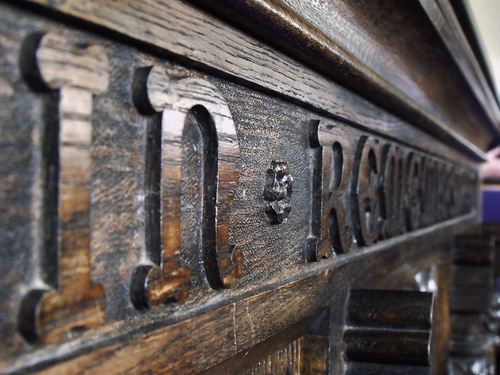
It’s New Testament wisdom, too. A few minutes after I ended this talk, we gathered for Communion, at a table etched with the familiar phrase that concludes this passage from Paul’s first letter to the Corinthians:
For I received from the Lord what I also handed on to you, that the Lord Jesus on the night when he was betrayed took a loaf of bread, and when he had given thanks, he broke it and said, “This is my body that is for you. Do this in remembrance of me.” (1 Cor 11:23-24)
 The Pietist Schoolman