Time to strike the set on 2011 here at The Pietist Schoolman. Things will be quiet here for a couple of weeks while Mrs. Pietist Schoolman and I travel to Britain and western Europe. But expect several reflections and photo essays to stem from that trip, as we’ll be scouting museums, memorials, and battlefield sites for my new travel course on the history of World War I. All that, and much more about our April 2012 Pietism studies colloquium at Bethel, to come in mid-to-late January here in this space.
While I’m away… If you’re new to the blog but came across it and are wondering what on Earth you’ve come across… Try the tab above entitled “What to Expect Here,” or browse through some of the series of posts I’ve written over the past six months:
(For longtime readers and newcomers alike… I’ll conclude this post with another set of recommendations: posts that I enjoyed writing but, for whatever reason, seem to have come and gone without attracting much attention. Skip down to those by clicking here.)
-

C.R.W. Nevinson, La Mitrailleuse (1915) - Tate Galleries Over There: my attempt to think through the very same WWI course that we’ll be scouting in person next month. Over twenty posts on WWI and related (usually) topics that fit somehow with what we would be doing at that point in the course. Start with the introduction, or check out the overview I published once it was done, indexing the posts by day/location.
- The Pietist Impulse: summaries of each of the eight sections in our book, The Pietist Impulse in Christianity. Whet your appetite and then go buy the actual book (or the Kindle version)! Again, you can start with the first post (on the challenge of defining Pietism) or peruse the overview/index.
- Anabaptist Critiques of Pietism: part of my summer research had to do with two famous critiques of Pietism by the mid-20th century neo-Anabaptist scholars Harold Bender and Robert Friedmann. We started with Bender and his “Anabaptist Vision” speech; start there or with this overview.
- Surprised by Oxford: not really a review of Carolyn Weber’s new spiritual memoir (which I did recommend highly) so much as a multi-part introduction that spurred reflections on everything from the nature of memoirs to varieties of Christian conversion. No overview this time: just start with part 1 and read on.
- Clouds of Witnesses: an oft-interrupted series looking at some of the individuals featured in Mark Noll and Carolyn Nystrom’s book about African and Asian Protestants in the 19th and 20th centuries. I got through the African chapters all right, but stalled in transition to India. I do intend to pick this up in the New Year, but then I’ve been promising that for a while now and the hiatus is into a third month… Anyway, here’s the introduction to the series; however incomplete, the stories are well worth learning.
-
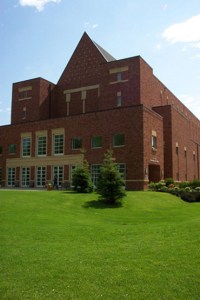
Benson Great Hall - Bethel University The Usable Past of Christian Colleges: the series most closely tied to my own research, this one considered an increasingly common theme among those who study Christian colleges: that their pasts — specifically, the particular Christian tradition(s) in which they’re rooted — are “usable” for contemporary educational leaders seeking to define their distinctive missions and identities. Specifically, I considered the “usable past” notion as it’s been employed (or rejected) by the historians and leaders of colleges and universities founded by American denominations shaped by Pietism. Here’s the introduction and the overview.
- Pietism, the BGC, and Bethel University: a follow-up to the “usable past” series, focusing more narrowly on my own employer (which invokes its Pietist past more than any other Christian college that I know) and its founding denomination (which seems less and less interested in those roots). Here I’m engaging pretty much exclusively in ressourcement, sharing the scholarship of other Bethel professors who have valued Pietism in the history of their college and church. We’re only two posts in: one on seminary historian Virgil Olson and another on college fixture G.W. Carlson. Look for at least one more in January, and then the series will continue intermittently as I’m able (or unable) to persuade some of my colleagues to offer their own perspectives on the subject.
- The Best National Anthems: reporting on my attempt (assisted by the students in my Modern Europe class) to rank the best national anthems, this series semi-seriously evaluated fifteen such songs. Start here with the introduction (which considers why this might not be an entirely silly exercise if you’re interested in the theory and history of nationalism) or skip ahead to the conclusion, which sought (and is still seeking, I should add) nominations for other anthems meriting consideration when I redo the exercise next year with a fresh set of students.
-

Jeff Tweedy of Wilco - Creative Commons (Greg Dunlap) Radio Kings: a non sequitur of a series that found me breaking from things like religious and military history in order to share my affection for two bands that released new albums this fall: The Jayhawks and Wilco. Then the series wrapped up with an extended reflection on what my love of their music means in light of my religious faith. (I also was part of a shared review of those two new albums, in conversation with Michial Farmer of The Christian Humanist Podcast and Blog.)
- Evangelicals and “Dominion”: not really a series so much as a two-part meditation on the flap over Republican presidential candidate (and evangelical Christian) Michelle Bachmann’s supposed embrace of “dominion theology.” Part 1 asked why the media still struggle to understand evangelical subcultures (I tended to blame my fellow evangelicals more than the media for that one), part 2 what “dominion” really means for the young evangelicals I teach.
- A Different Significance: another two-part post… A slightly revised version of a November 2009 talk I gave reflecting on my limited experience with online education (the focus of part 1) and why it was both advantageous and problematic for schools like Bethel (part 2).
- The Fear of Preaching/A Stretched People: finally, not labeled a series but a before-and-after pair of posts: the first sharing my terror at having been invited to preach for the first time in my life (on a passage from Revelation!) and then the second being the text of the sermon that resulted from that invitation.



Then here are a few posts that just didn’t click when I first posted them but might be worth a second look:
- This Day in History: Peace vs. Justice (October 24): The United Nations turning sixty-six got me thinking about a basic tension in international relations: between those who think that peace should be the ultimate end of the international system and those who would prioritize justice, even at the expense of conflict.

Neville Chamberlain in Munich, September 1938 - Bundesarchiv - Chamberlain and Churchill: Empathy, Judgment, and Hindsight Bias (November 18): Note to self: don’t lengthen titles by adding multiple jargon-y terms. If I’d just left it “Chamberlain and Churchill,” perhaps a few more than the nineteen people who clicked this link would have read my reflection on the appeasement debate as a case study of the challenge of balancing the historian’s desire to empathize with the tempation (obligation?) to render moral judgments.
- 600 and 3000 (August 17): Then there are the titles that are brief but far too enigmatic. Would you have guessed that this one found me connecting a rare bright spot in the 2011 Minnesota Twins season with the career of one of the most prestigious New Testament scholars in the world? Of course not. Why would you?
- College Architecture and Christian Simplicity (November 15): It sounds ungrateful, but I think I stand by my concern with the fact that Bethel wants to spend millions of dollars to upgrade its facilities and provide my students with better learning environments.
- “God Made the Country” (September 1): Not sure why this one didn’t get an audience (maybe everyone had left early for Labor Day), but in any case, I enjoyed thinking through my surprising fascination with the rural and agrarian.

 The Pietist Schoolman