
You can tell I’ve resolved several big projects and am mentally entering Spring Break because I actually took half an hour Monday to answer a question that’s been nagging since the Academy Awards last weekend:
Do the Oscars tend to favor movies set in the past?
Of course, the antebellum historical drama 12 Years a Slave won the Best Picture Oscar, beating out several competitors that were set in a period at least a decade removed from the immediate past (Philomena reached back to the 1950s, American Hustle to the late 1970s, Dallas Buyers Club the mid-Eighties, and The Wolf of Wall Street the Nineties). Though certainly constructed by imaginations not restricted by the rules accepted by professional historians, they were set in a time recognizably other than the present.
So is that a typical outcome of the Oscar race?
As best I can discern (I blame Wikipedia for all errors), 49 of the 86 Best Picture winners have been at least partly set in a period at least 10 years prior to their award. Here that same category is broken down by decade:
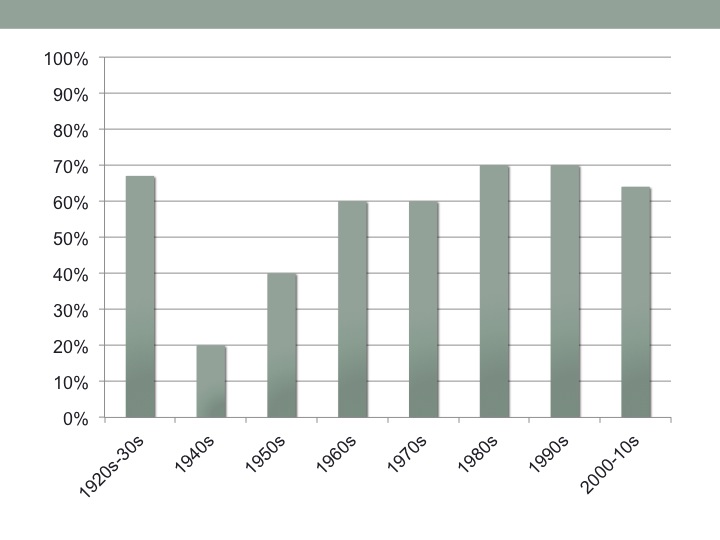
What stands out most clearly is the popularity of contemporary settings in the 1940s and 1950s. Indeed, in the sixteen-year stretch from 1942 to 1957, there’s only one Best Picture winner that really seems like a historical drama, except that it’s a comedy: Around the World in 80 Days (1957, set in 1872). There are also two in that period that go back only as far as World War II — From Here to Eternity and The Bridge on the River Kwai (Casablanca and Mrs. Miniver were made about that war during that war) — and All the King’s Men, the 1949 winner set primarily during the Great Depression.
Conversely, we seem to be in the midst of a prolonged period in which Oscar voters prefer movies set relatively far back in the past. Out of the last thirty Best Picture winners, nineteen have been set at least a quarter-century before the year of their award. Thirteen go back at least seventy years: (in order of temporal distance)
-
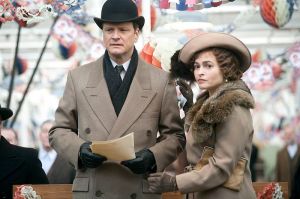
Colin Firth and Helena Bonham Carter filming a scene from The King’s Speech at Lancashire’s Queen Street Mill Textile Museum – Creative Commons Gladiator (awarded 2000, set late 2nd century AD)
- Braveheart (1995, late 13th and early 14th centuries)
- Shakespeare in Love (1998, 1593)
- Amadeus (1984, late 18th century)
- 12 Years a Slave (2014, 1841-1853)
- Dances with Wolves (1990, mid-1860s)
- Unforgiven (1992, 1880s)
- Titanic (1997, 1912)
- The Artist (2013, late 1920s)
- Chicago (2002, mid-1920s)
- The King’s Speech (2012, starts 1925, mostly late 1930s)
- Out of Africa (1985, mostly 1910s)
- The Last Emperor (1984, at least partly 1910s)

 The Pietist Schoolman