How did Paul Wellstone attempt to implement these moral principles in his political activity and explore their meaning to a society committed to “liberty and justice for all”?
First, through the endorsement of the Health Security for All Americans Act, Wellstone expressed his commitment to an expanded health care system.
Its first premise was that “every American is entitled to have health care coverage as good as what members of Congress get.” Second, a good health care system “must be affordable. Americans should not go broke trying to keep their bodies fixed.” Third, all citizens “must have access to care when they need it. That is why it includes strong patient-protection provisions.” Fourth, good health care delivery doesn’t just happen. It depends on a “well-trained, well-compensated healthcare workforce that doesn’t have to worry constantly about where the next dollar is coming from.” (Conscience of a Liberal, pp. 48-49)
Second, Wellstone — with Sen. Pete Domenici (R-NM) — built a bipartisan coalition to explore ways to deal with mental health issues.
The “strategy for change was threefold: a compelling message – end this discrimination; education showing that mental illness is a diagnosable and treatable disease; and grassroots organizing by citizens’ groups to fight for change.” (Conscience, pp. 64-65) There were other coalitions that dealt with issues such as substance abuse and children’s health.
Third, Wellstone was deeply committed to early childhood education and access to strong and competent childcare.
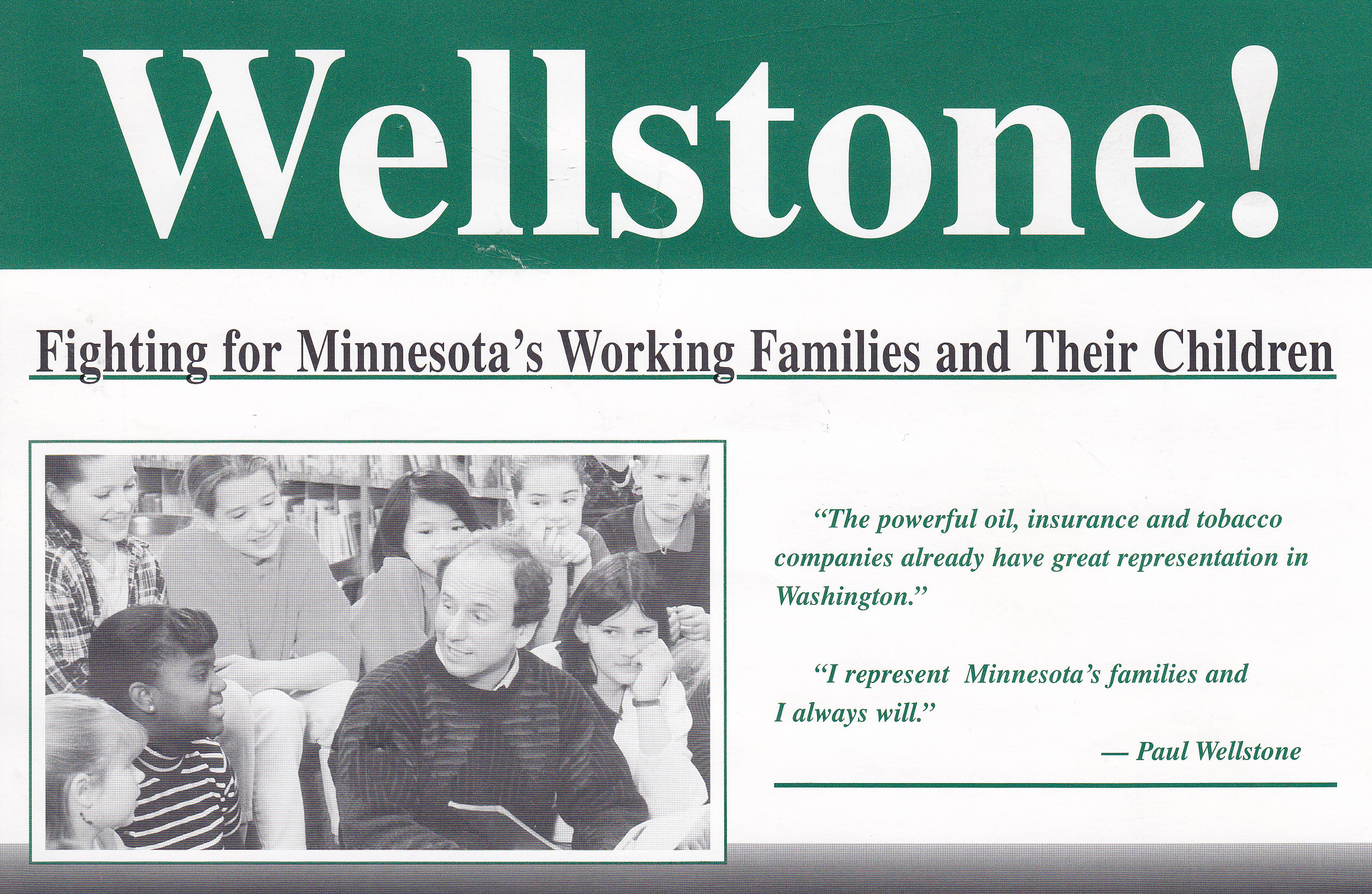
He supported the Family and Medical Leave Act and Child Care Development Block Grant. He believed that “equal opportunity” would be significantly enhanced if “all children had access to early childhood education.” He wrote that
an honest commitment to children means special attention to them in the critical years of their lives. We need a national commitment equivalent to the efforts to build our vast network of federal highways, to the moon shot or to the GI Bill –the very best developmental childcare supported in every community in our country. The federal dollars would support community-based programs. This is where the federal government could be and should be a real player –investing money in prekindergarten education. To date, our response has been pathetic. The proposition that our country with all its affluence, in a time of record performance, cannot afford to help children during these critical early years is unacceptable. (Conscience, 77-78)
Fourth, Wellstone attempted to promote a living wage proposal that would allow families to have a reasonable chance at having a way out of poverty through work.
A minimum wage does not allow people the opportunity to access housing, health care, food, and clothing. Many have to retain an access to soup kitchens and food shelves. Wellstone argued that “it is long past time to raise the minimum wage to a livable wage. Making work pay, combined with providing affordable childcare and health care, would dramatically raise family incomes. These policies are vitally important to working families. Moreover, they are absolutely consistent with the values Americans hold dear about work, children and families.”(Conscience, pp. 106-107)
Fifth, Wellstone believed that there was a need place some limits on the irresponsible influence of wealth on the political process and public decision-making.
He was a strong supporter of the McCain-Feingold legislation because he strongly believed that the voices of working people and poor were not able to gain access to the institutions of power. He wrote that “we do not have a true democracy because our political system does not work for the people. Instead, well-paid corps of lobbyists and moneyed interests perpetuate the status quo. These power brokers rob the people of their ability to exercise authority, at least in free and open elections in which the best ideas and the best candidates prevail.” (Conscience, p. 149)
 The Pietist Schoolman
One thought on “Paul Wellstone: The Conscience of a Liberal (G.W. Carlson)”