One of my favorite blogs is Past Imperfect, produced by the Smithsonian Magazine and featuring terrifically well-written stories about a fascinating array of historical subjects. (A piece on female pirates won one of the last Cliopatria awards for historical blogging before Cliopatria closed down.) Well-researched but accessible, I’ve taken to recommending several of its best posts on the “Weekend Reading” post I do every Saturday morning for our department blog.
My favorite writer at P.I. is Mike Dash, who (at least in recent months) has been right in my ballpark, writing about European and diplomatic history topics as diverse as an inflation crisis in 17th century Germany, pigeons in World War I, and a post on the Sino-Soviet split called — to my glee, since I mention the episode to which it alludes every time I teach my Cold War history course — “Khrushchev in Water Wings.”
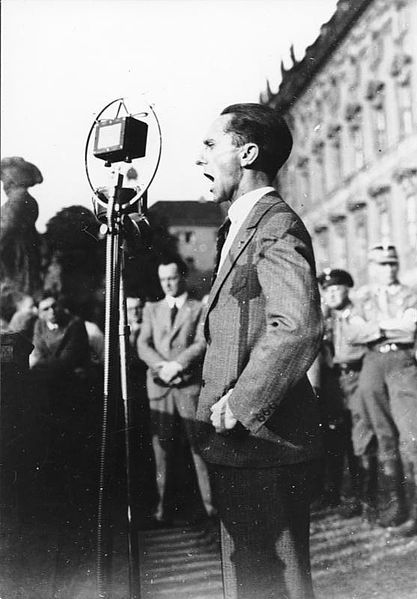
But I think his post published today tops them all: the story of Charlie and His Orchestra, an innocuously titled ensemble of jazz musicians put together by Josef Goebbels as a Nazi propaganda device.
Now, I was dimly aware that the operetta-loving Hitler disdained the jazz that proliferated in interwar European cities. And it wasn’t surprising to find that one Nazi official issuing ten regulations for jazz music in Bohemia, including:
- Preference for “compositions in a major key and to lyrics expressing joy in life rather than Jewishly gloomy lyrics”
- Zero toleration for “Negroid excesses in tempo (so-called hot jazz) or in solo performances (so-called breaks)”
- Requiring that at least 90% of compositions feature “natural legato movement devoid of the hysterical rhythmic reverses characteristic of the barbarian races and conductive to dark instincts alien to the German people (so-called riffs)”
- A ban on cowbell, plus the “mutes” used by trumpeters to “turn the noble sound of wind and brass instruments into a Jewish-Freemasonic yowl (so-called wa-wa, hat, etc.)”
- And prohibiting the plucking of strings, “since it is damaging to the instrument and detrimental to Aryan musicality”
But while Goebbels agreed with protecting German ears from “Jewishly gloomy lyrics” and the other features of such “degenerate music,” he apparently decided that there was no reason that musical forms “alien to the German people” couldn’t be used on non-Germans to propagandistic effect. He recruited a politically-flexible tenor saxophonist named Lutz “Stumpie” Templin to lead a band that featured the vocal stylings of a fluent English-speaker from the Foreign Office named Karl Schwedler: i.e., “Charlie.”
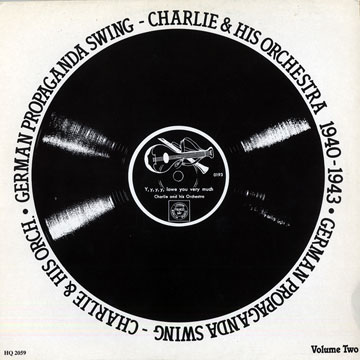 While “Charlie” would usually play it straight on the first verse of the American songs the band played,
the remainder of the lyrics would veer wildly into Nazi propaganda and boasts of Aryan supremacy. Charlie’s main themes were familiar ones: Germany was winning the war and Churchill was a drunken megalomaniac who hid in cellars at night to avoid German bombs (“The Germans are driving me crazy/I thought I had brains/But they shot down my planes”). Similarly, Roosevelt was a puppet of international banking cartels, and the entire Allied war effort was in the service of “the Jews.” For the most part, Schwedler’s songs interspersed virulent anti-Semitism with attempts to convince his audience that Nazi victory was inevitable. When Cole Porter’s classic “You’re the Top” got Charlie’s treatment, the revised lyrics emerged as “You’re the top/You’re a German flyer/You’re the top/You’re machine gun fire/You’re a U-boat chap/With a lot of pep/You’re grand,” and the lyrics for “I’ve Got a Pocketful of Dreams” became “I’m gonna save the world for Wall Street/Gonna fight for Russia, too/I’m fighting’ for democracy/I’m fighting’ for the Jew.”
Apparently the band was proficient but not all that great, and Allied POWs weren’t the fans Goebbels hoped they be.
Read the rest of the story here.
 The Pietist Schoolman