Some highlights from the past week at this and other blogs and publications.
Here
- We paid tribute to one of my favorite hometown bands as they returned to putting out albums after a prolonged absence. Not a huge fan of the new CD, though the documentary mini-features (including an early, early video of a sound check) were welcome.
- We wrapped up one series (on Pietism as offering a “usable past” to Christian colleges like Bethel University), while two other series continued: the “Michaelmas” term in Carolyn Weber’s spiritual autobiography, Surprised by Oxford; and two more African stories from Mark Noll and Carolyn Nystrom’s Clouds of Witnesses.
- Some fun with Google searches that somehow end up here.
- “This Week in History” featured a Korean martyr, an Irish Nazi, and a royal visit.
Elsewhere
-

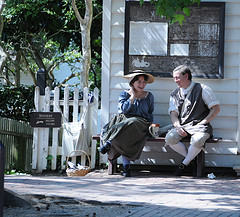
Licensed by Creative Commons (Serge Melki) Looking at the description of Colonial Williamsburg’s new online learning site, John Fea sees further evidence that the powers that be at CW “have moved away from the ‘consensus’ narrative that has been at the heart of their interpretation of early America for decades and are now engaging in a ‘conflict’ narrative centered around competing narratives of American life.” (My first year at the College of William and Mary, I lived in Hunt Hall, right across the street from the colonial recreation. Surreal.)
- Mark Oppenheimer continues to contribute interesting religion coverage to The New York Times, reporting on an aspect of the Goshen College decision not to play “The Star-Spangled Banner” that I hadn’t heard: how it was received in the subculture of student-athletes at Mennonite schools like Goshen.
- What a “classic postmodern parenting tale” tells this Canadian Mennonite pastor about baptism. (H/T CC Blogs)
- I don’t know whether I’d be more excited to take this class, or teach it myself…
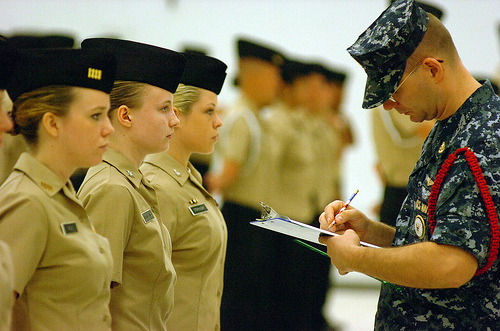
- The Navy ROTC program restarted at Harvard, and Yale will offerAir Force and Navy ROTC units starting next fall. Understandably, news coverage is focusing on these announcements being responses to the end of the military’s “Don’t Ask, Don’t Tell” policy. My perspective is a little different. I was finishing grad school at Yale (and TA-ing in a military history course) when the Iraq War began and the debate about ROTC flared up. One of the key issues then was the scarcity of national university graduates in the military’s officer ranks, overlapping with a concern that relatively few officers came from the Northeast.
Licensed by Creative Commons (U.S. Navy) - How many slaves work for you? Cathleen Falsani points us in the direction of the Slavery Footprint campaign, which takes some basic economic information from participants and estimates their connection to industries relying on present-day slavery. We’re connected to a global economy that employs at least 27 million forced laborers, so if you take the survey, prepare for the number to be much, much larger than you’d have imagined. The Slavery Footprint server was down (due to overwhelming traffic) when I tried it this morning, but I’ll update this post with my answer to the question as soon as the survey is available again.
 The Pietist Schoolman