September 12, 1977 – My brother is born
While this indirectly leads (through a combination of rough-housing and my lack of coordination) to my visiting the emergency room at least half a dozen times in our shared childhood, it’s still worth celebrating. Happy Birthday, Jon!
September 13, 1916 – Mary the elephant is executed
See, American history is just so much weirder than Europe’s….
Accounts vary, but for whatever reason, a five-ton elephant named Mary killed a drifter-turned-circus worker named Red Eldridge in Kingsport, Tennessee. The circus owner decided that he had no choice but to kill the elephant, but it was a struggle to arrive at an effective method of capital punishment. (Firing squad was ineffective. Electrocution wasn’t really feasible. Being torn apart by two locomotives was judged too cruel.)
 Ultimately, they opted for hanging, using a railroad derrick car in the nearby town of Erwin. (The first chain snapped, causing a fall that broke Mary’s hip; the second was stronger and suspended the elephant for half an hour — see right.) To mollify circusgoers expecting a pachyderm in the show, the owner invited any and all to attend the execution for free. About 2500 showed, including “every child in Erwin,” according to one such eyewitness in this oral history.
Gotta love the beginning of that piece:
It was 1916, and things were changing fast. World War I raged in Europe. Dadaism, ripe with comic derision and irrationality, took hold in artistic circles. Freeform jazz took hold of the American music scene. Margaret Sanger opened the first birth-control clinic. It was a good year for scapegoats. It was a good year to hang an elephant.
Battle of Verdun, Dada, ragtime, contraception, capital punishment for circus animals…. Yes, it’s all of a piece.
September 14, 1901 – Pres. William McKinley dies
After being shot eight days earlier by an anarchist named Leon Czolgosz.
Of the four presidential assassins, Czolgosz probably ranks #4 in a tight race with Charles Guiteau as the least known. I tend to rank him higher. In part, I think I have an odd affinity for another person whose name has such a high consonant-to-vowel ratio (his 3:1; mine 4:1), plus twice as many Z’s as mine. (The defeater for this theory: I hate Duke’s basketball team, despite the name of its coach.)
More, it’s that McKinley is a much more important president than most people like to admit. Not as significant as Lincoln, but obviously more than Garfield (if only because of time in office) and, I think, than JFK.
McKinley’s meaning in American history (primarily centering on the Spanish-American War and the annexation of the Philippines, both of which he endorsed reluctantly) is well described in humorist Sarah Vowell’s wonderful book Assassination Vacation, an appealing combination of irreverent presidential history, contemporary political and social commentary, and semi-creepy travel writing. (It’s about her tour of sites related to the three Republican presidents assassinated between 1861-1901 and their assassins.) I don’t always agree with her conclusions, but it’s refreshing to find history written with such evident joy for the subject — a quality often lacking (or suppressed) among us professionals.
But even Sarah Vowell struggles to make Leon Czolgosz entertaining or interesting. (For a much more compelling and empathetic portrait of an anarchist who embraced murder as a political weapon, read John Merriman’s The Dynamite Club, which I’ll probably discuss next month when my Modern Europe students encounter its killer, Émile Henry.) She frequently alludes to the musical Assassins, but has to admit that “Even Stephen Sondheim cannot tart up Leon Czolgosz. Czolgosz is such a sad pathetic figure, and by pathetic I mean drowning in pathos, that he is the one psycho killer in the musical Assassins who never gets a laugh. He is as drab and morose as Charles Guiteau is snappy” (p. 214).
Still, Czolgosz’s assassination of McKinley yields its share of interesting nuggets, such as:
- McKinley’s widow, Ida, “sewed a picture of her murdered spouse into her knitting bag and then spent the rest of her life in a rocking chair, crocheting four thousand pairs of bedroom slippers, seeing her dead husband’s face staring up at her every time she reached for a new ball of yarn” (192).
-
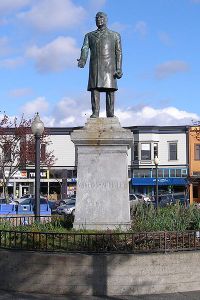
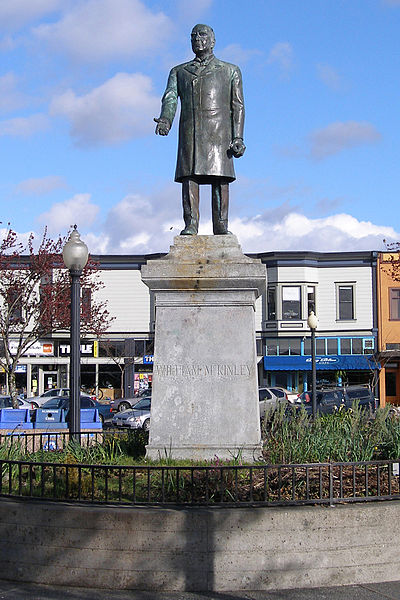
Licensed by Creative Commons (J. Scott Shannon) There is a memorial statue of McKinley in the town plaza of Arcata, California that has been the subject of some unusual vandalism: most famously, having its nose and ears stuffed with cheese in 1986.
- The morning he was assassinated, McKinley and his wife went up to Niagara Falls (he was in Buffalo, NY for the Pan-American Exposition). While many Americans cross to the Canadian side for a better view, McKinley declined — he didn’t want to be the first sitting American president to leave the country. Only five years later, McKinley’s colorful successor set the precedent when he visited Panama to see its canal, then under construction.
- Speaking of… Teddy Roosevelt rushed to Buffalo when he received news of McKinley’s shooting, but was sent away by the president’s aides when it seemed that McKinley might recover. So TR happily returned to his family vacation in the Adirondacks, and took his sweet time coming down the mountain after receiving a telegram announcing that McKinley was critically ill and had no hope of survival. (His first reaction was to finish his lunch). The president died while Roosevelt was still en route to the railroad station, by way of a friend’s hunting lodge.
- Czolgosz barely survived being beaten by the onlookers of the assassination (thanks to McKinley, who told his would-be avengers to “go easy” on the assassin), was tried and convicted in a mere eight hours (in a trial that started just nine days after McKinley’s death), and (unlike Mary the elephant) was electrocuted. The electricity used was George Westinghouse’s alternating current (AC), for which rival Thomas Edison had campaigned, thinking it would make his direct current (DC) seem more attractive. This, of course, didn’t stop Edison from using the event to promote another of his inventions: the motion picture. He had the execution reenacted and filmed (click to watch); the movie’s director was Edwin S. Porter, who two years later made The Great Train Robbery, a landmark in the development of the feature film.

September 15, 1938 – Thomas Wolfe dies
That is, the author of Look Homeward, Angel, You Can’t Go Home Again, and other novels and plays.
Not the writer of The Right Stuff, The Bonfire of the Vanities, and several other works of fiction and non-fiction.
Which made me wonder: there are lots of celebrities who share the same name (queen/actress Jane Seymour; naval captain/bass player John Paul Jones; singer/senator Paul Simon), but any others so famous who share both name and profession?
September 16, 1630 – The village of Shawmut, Massachusetts changes its name
…to Boston.
Shawmut was founded by Rev. William Blaxton in 1625, when he built himself a cabin on the site of what’s now Boston Common. Five years later, a large group of English Puritans arrived at Massachusetts Bay and were invited by Blaxton to settle at Shawmut, which they renamed in honor of the English town from which most of them originated.
Just imagine how history might have changed if they’d stuck with the original name… Would Henry James have written about The Shawmutians? Would a band called Shawmut have sold seventeen million copies of their self-titled debut album? Would the ShawSox have gone eighty-six years between World Series victories? Would they have sold Babe Ruth in the first place?
 The Pietist Schoolman
What a great way to start the week! Love this trivia.